Ramadan: "is the ninth month of the Islamic calendar. It is the Islamic month offasting, in which participating Muslims refrain from eating, drinking and sexual relations fromdawn until sunset.[1] Fasting is intended to teach Muslims about patience, humility, and spirituality. It is a time for Muslims to fast for the sake of God (Arabic: الله, trans: Allah) and to offer more prayer than usual. During Ramadan, Muslims ask forgiveness for past sins, pray for guidance and help in refraining from everyday evils, and try to purify themselves through self-restraint and good deeds. As compared to the solar calendar, the dates of Ramadan vary, moving backwards about eleven days each year depending on the moon. Muslims believe Ramadan to be an auspicious month for the revelations of God to humankind, being the month in which the first verses of the Qur'an were revealed to the Islamic prophet, Muhammad" (Wikipedia)
In Senegal, Ramadan and fasting is observed by almost everyone, except for the small percentage of Catholics, and even then, I think they are somewhat forced to observe it because essentially the entire country changes it’s pace of life from slow, to barely moving for a whole month. I had said to myself before the holiday started “ I am not fasting, no way, I neeeeeed to eat!”. Well, was I wrong, since I pay my family to include me in cooking the meals, there is only food and beverages when they eat, which during Ramadan is only between sundown and sun-up. This wouldn’t be so bad if it wasn’t rainy season and peak agricultural production season also. My typical day is as follows:
5 am: Xudd (my breakfast, but what is typically served for dinner) A porridge of some sort, or bread and sour milk (like yogurt or buttermilk), or millet and beans. All not so bad, but takes a bif of getting used to so early in the AM.
8-9 am: wake up, NO coffee means NO caffeine… I struggled with this the first few days for sure.
9- 11 or 12: work. This is typical for almost everyone to be working at this time.
12-6 pm: sitting, talking, watching tv, LOTS of reading
6-7pm: I have to exercise to salvage my sanity; 12-25k bike ride, depending on weather and heat.
7:28pm: Breaking Fast!!!! We start backwards from meal times so Breakfast is first, then lunch, etc. We have bread and butter with spiced coffee (Café Touba). Then we are given glass after glass of sticky, minty, limey, sweet Bissap (hibiscus) juice. WITH ICE!
8:30/9 pm: Lunch. This is the biggest meal, and is what we typically would eat during the lunch hour…lots more veggies in the bowl, chicken or other “meat” 2-3 times a week. Often followed by a smoothie like concoction of powdered milk, pineapple or mango juice, and bananas, or Orange Soda.
10:30 pm: Snack, tea. I am usually in bed by this time, either reading or doing stuff on the computer, but when I am not we roast corn over the fire.
So that’s that. It is rough not to drink during the day, and I am not going to lie, but I have cheated on the water thing a lot. I hate the feeling of dehydration, but my body has gotten really used to the food thing. I was grateful to get the care packages my parents sent, because it allowed me to eat AFTER dinner too, and stuff that was yummy like fig newtons and chocolate.
I think Ramadan wouldn’t be all bad, but I have a few qualms with the idea that people here do it because everyone else does regardless of their religious convictions (kind of like Christmas for Americans). The time is meant to reflect more deeply on your spirituality, and get closer to God…unfortunately it is not practiced as that here, since most people have never even read the Koran. But my biggest problem, comes down to the women and children. The Koran specifies that women who are pregnant, nursing, and menstruating should not fast. The same goes for children below puberty. I have talked myself in a circle of this fact, since the kids and mothers are typically malnourished to begin with, it often makes the situation worse. Of course people here say “you’re not Muslim, how do you know it’s bad”, so I say “can you read the Koran, do you know what it says?” This confrontation is usually between myself and a teenage to 20 something male, so it’s OK for me to be a bit snarky.
I was rather upset at my very pregnant sister who was fasting, and my sister who is breastfeeding. They just told me I didn’t “understand”. Despite all of it, my sister has stopped producing enough milk and my other one has a bad bad respertory infection (along with all the kids who eat mainly stale bread and old rice all day). I think what bothers me is that they ask me for advice, medicine, money, but as soon as I have something useful to offer, something that is important for health and wellbeing, they ignore it. Oh Senegal.
SO; after 1 month of not leaving the village, after fasting the whole time, after no beer or wine, after killing and plucking chickens all by myself, after a rain storm knocked down one of the huts in my compound, after a giant rat attacked a goat and we ate the rat for dinner, after both schizophrenic adults in my village came to my hut…I headed to my regional house, where I currently have a beer in my hand, and an abundance of food. (note: I still have 1 week or so of Ramadan when I head back).

We came, We saw, We trained
IST finally drew to a close. In addition to the things I listed in my last blog post, we also did sessions on tree outplanting, how to hold HIV/AIDS trainings, effective strategies for doing causeries (demonstrations of technical information to the public) and a NGO fair that introduced us to some of the other aid organizations working in Senegal, and basically what they did. For the most part the second week was pretty lack-luster. I did however enjoy the beekeeping field trip we went on! The man who we toured with was very knowledgeable about the type of problems we might face in the village with our communities, and also offered practical advice and alternatives to the traditional box style hives used in the west. The Gambia Peace Corps program has a fairly established project going on for keeping bees, and also a training. I would love to get involved with this as side project, since I live in an area with numerous tree pepineres and community gardens.
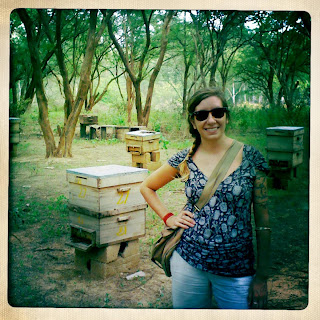
After IST, we spent another lovely weekend at the beach, and then I was off to Dakar.
Dakar is a wonderful place ( I say this in the context that I live in a village and therefore think ANY city is nice.) But it really does have most of the things you want in a city: food, music, clubs, and a beach! As PC volunteers we get free admission into the American Club (a country club with volley ball courts, pool, tennis court, and of course drink specials and food). I was in Dakar a week before our IST started, and then again for a few days afterward. I got to eat REAL cheese and REAL ice cream and the best authentic Chinese food I have ever had (thank goodness we had a native Mandarin speaker with us). For a bit I was able to forget that I was in developing West Africa, and just do somewhat normal things any 20-something would be doing in a large city. I guess that’s the problem with the developing world, all of the money is centered around metropolis areas where a fraction of the population is able to live and work, leaving the rural areas forgotten.
Needless to say, I was ready to head out of the city and back to my hut!
When I arrived back in my village, to my utter dismay, my garden had not been watered, and there had been only 2 seasonal rains the entire month. My plants were almost dead, and my watermelon was very dead. I was not a happy camper with my host sister who had watered my garden previously, and she offered to me no explanation to why she didn’t. After a week and a half of coaxing, they are all nearly back to normal, just a few weeks behind in maturation. I have 3 cucumbers that will be ready for picking very soon!!!
I was able to participate in a Universal Nut Sheller demonstration. The UNS is a simple concrete and metal machine that, with the help of a hand crank, shells nuts, most notably peanuts. Since I live in the peanut basin of Senegal, this technology is well received. If you have good dry nuts, it shells peanuts 40 times faster than women can do it by hand. I personally have the calluses to prove that 40 hours of shelling peanuts SUCKS! The cost is minimal (about $75 US) and is a great investment by a woman’s group, or co-op. Hopefully, the women we showed it to connected the labor and time trade-off, a connection that is hard to put across in a country where time is not valued, and is not related to how much money you can make. As one person put it “ what will I do with all that extra time during harvest season?”.
http://www.thefullbellyproject.org/

In other news, my 12 year old sister is “takked’ the Wolof equivalent of engaged. While I have been uncomfortable in many cultural situations in this Muslim country, this is by far the one where I want to scream EWWW at the top of my lungs but cannot. I have never been one to much hold my tongue, so watching all of this occur in my compound in front of my own eyes is disturbing. Yet, I do what I can by saying that she has to finish school before they get married. The marriage isn’t planned for 5 years, which is some relief, but since she began menstruating last month, she was old enough to be promised to someone. He is close to me in age.

After IST, we spent another lovely weekend at the beach, and then I was off to Dakar.
Dakar is a wonderful place ( I say this in the context that I live in a village and therefore think ANY city is nice.) But it really does have most of the things you want in a city: food, music, clubs, and a beach! As PC volunteers we get free admission into the American Club (a country club with volley ball courts, pool, tennis court, and of course drink specials and food). I was in Dakar a week before our IST started, and then again for a few days afterward. I got to eat REAL cheese and REAL ice cream and the best authentic Chinese food I have ever had (thank goodness we had a native Mandarin speaker with us). For a bit I was able to forget that I was in developing West Africa, and just do somewhat normal things any 20-something would be doing in a large city. I guess that’s the problem with the developing world, all of the money is centered around metropolis areas where a fraction of the population is able to live and work, leaving the rural areas forgotten.
Needless to say, I was ready to head out of the city and back to my hut!
When I arrived back in my village, to my utter dismay, my garden had not been watered, and there had been only 2 seasonal rains the entire month. My plants were almost dead, and my watermelon was very dead. I was not a happy camper with my host sister who had watered my garden previously, and she offered to me no explanation to why she didn’t. After a week and a half of coaxing, they are all nearly back to normal, just a few weeks behind in maturation. I have 3 cucumbers that will be ready for picking very soon!!!
I was able to participate in a Universal Nut Sheller demonstration. The UNS is a simple concrete and metal machine that, with the help of a hand crank, shells nuts, most notably peanuts. Since I live in the peanut basin of Senegal, this technology is well received. If you have good dry nuts, it shells peanuts 40 times faster than women can do it by hand. I personally have the calluses to prove that 40 hours of shelling peanuts SUCKS! The cost is minimal (about $75 US) and is a great investment by a woman’s group, or co-op. Hopefully, the women we showed it to connected the labor and time trade-off, a connection that is hard to put across in a country where time is not valued, and is not related to how much money you can make. As one person put it “ what will I do with all that extra time during harvest season?”.
http://www.thefullbellyproject.org/

In other news, my 12 year old sister is “takked’ the Wolof equivalent of engaged. While I have been uncomfortable in many cultural situations in this Muslim country, this is by far the one where I want to scream EWWW at the top of my lungs but cannot. I have never been one to much hold my tongue, so watching all of this occur in my compound in front of my own eyes is disturbing. Yet, I do what I can by saying that she has to finish school before they get married. The marriage isn’t planned for 5 years, which is some relief, but since she began menstruating last month, she was old enough to be promised to someone. He is close to me in age.


" Nothing happens unless someone wills it to happen.” William S. Burroughs
Well, it was long road to hoe this last month, but I finally made it to my In Service Training! During IST, we are back together in our original training group from March, and are constantly barraged by technical information. The format is same as training, but we have significantly more freedom, and a little more liberty in choosing if we go to a particular session or not. During week one I learned how to run a radio show, and use the software Audacity. We made sample Public Service Announcements, about things like AIDS, nutrition, and basic sanitation practices... we also did some funny PSA's. We spent 2 whole days on Permaculture....I love gardening, and as you will see below, my garden is doing quite well! Here are some relevant links on Permaculture models and practices; if you garden DO IT!
Obama is listening…are you? Radio jingle.
Right about now you're probably wondering what I have been doing with my life the last month? Beside the typical every day book reading (so far I have read 20), gardening, and talking with my family heres a better idea of what I have been up too...
Girls Camp: In my last post I mentioned a girl's camp I was getting ready to attend, in which I was put on the activities committee. The camp was held in Sokone, and organized as a regional project by volunteers in Kaolack. The venue was BEAUTIFUL. It sat on the edge of the water in a protected park of mangroves and monkeys! The camp was directed to girls who are finishing "sixieme", which in theory are girls around the age of 12, but in Senegal, lying about or not knowing you're age is common, and if you do not pass you're exams, you cannot enter the next grade level, thus our 27 girls ranged in age form 10-18 (the educational system is a whole other story). Each day was organized by a theme (environemtn, health, careers, etc.), and each day was broken down into sessions and activites; like an American summer camp.
I inherited responsibility for the day on Health. We did a demonstration on hygeine in the compound (strategies to reduce the oral-fecal cycle among children and dirty sand), a nutrition session (food groups), a personal fitness session, and an open discussion about sex and women’s health. Of all the times I have spent here, the 2 hours where the girls were open and honest about sexual health was the biggest “win” for me. The girls were craving knowledge about sex and sexual health…”how do I get birth control and where?”; “How do I avoid AIDS?” “How do I treat a yeast infection?” etc. etc. They were so happy for the knowledge and just being able to talk about these things; topics that are typically taboo in Senegalese culture.On my Picasaweb account are a few pics of me starting my discussion and leading the household hygiene session.
Epic bike trip and 4th of July:While everyone in America was preparing for BBQ's, playing with fireworks, and sitting on lawn chairs celebrating the great country of freedom, I was packing 5 days worth of belongings onto the back of a bike with elastic bands made of old tire tubes. Along with 4 other Peace Corps Volunteers and 1 employee from an American NGO, we readied ourselves for a 4-ish day and 200 Kilometer bike ride through Senega'ls Niokolo Park, with our destination being in the far Southeast of the country where our Peace Corps 4th of July party would take place.
View Larger Map
When we headed out of town we looked like a band of homeless people, all of our possessions strapped onto narrow bike platforms and covered with pieces of blue tarp.
The first day was fairly leisurely, about 70K all before we started into the park, we stopped after the first 2 hours when we saw a group of other volunteers on the side of the road eating sandwiches. Another 40K later, not 30 as we had planned, and with the 12:30 sun beating down, we made it to our first resting place; a beautiful campemant on the Gambia River.
We were all really tired after the first 85-ish K that day, and lounged in hammocks watching hippos swim for the rest of the afternoon. That night, we stayed in a friends village, and as per usual, the village food was not filling or very nutritious, plus we were all exhausted. We ended up not having enough mosquito nets and 3 to a bed. Needless to say we barely slept.
In the morning, we headed off at 6 am, and after calculating the pace we had been going the day before, figured we would be at our first resting place inside the park by 12. It was 25K before the park entrance, and we checked in with the park rangers, where they explained we would not have access to any food or water until a station 80K into the park...not a problem as we had planned accordingly.
After the first 70k, we stopped to rest, as we had thought we would reach a checkpoint or guard station in the park, but had not. Another hour of biking later, we came to the realization we were not near a guard station, and all had less than a liter of water each; one person had ducked into the shade and taken off all his clothes because he felt himself beginning to overheat, and had stopped sweating. Another person was so heat exhausted, that she blacked out and was vomiting on the side of the road incoherently. All I could think of was wanting rain, too cool us off, and for a car to drive by.
While we were resting we were approached by a group of rather angry baboons, who began to threaten us by whooping loudly and throwing sticks...the head male was enormous, and decided he wanted to come over to check us out. I did not want to be involved, so I grabbed all of my stuff and headed as far out of the forest I could get. Right after I left, a group of warthogs came traipsing through our makeshift camp, looking rather unhappy. Just as we were finding a new spot, the world decided to end, and the sky opened up and began lightening and thundering, and raining harder than I have ever seen in my whole life. We went from all being overheated, to nearly freezing in dripping wet clothes, and at a temperature of about 65 degrees. We decided to take the opportunity to collect rainwater for our bottles...the rain lasted about 2 hours; for that time we mainly just huddled under a tree and shared the 2 rain jackets that I and another girl had packed.
When the rain finally did stop, soaking wet, out of food (we ate mostly power bars and bread the whole day) and had no idea how far we had to go. After another 60k of biking, we stayed at a campemant that served us a hot meal and cold beer, offered us showers and comfortable beds. It was such a relief.
We woke up on the third day all sore and tired, but willing to ride the last hilly 30k to Kedegou. After washing our bikes of the caked on mud, and refilling 30 water bottles...the sun was already blistering hot. A group decision was made to strap our bikes to a vehicle and just catch a ride, one of the best decisions I ever made!
The 4th of July party was amazing! A hotel with a pool, 3 roasted pigs, coleslaw, Gissap (Gin and Bissap juice), fireworks, and 100 or so volunteers. A great end to my adventure.
Baseline Survey: After returning from Kedegou, I wanted to start my household survey. The purpose of this type of survey is to gauge community wants and needs. Since I live in a larger village (about 3000 people), the baseline assessment like this is a little more difficult to do than a village of 300 people. Since my village is large, I am using a mix of sampling (where I chose a randomized number of households to interview), observation of behaviors and structures, and talking to village leaders. The questions range from “number of compounds in village” to “number of pregnant women”. So far I have interviewed the president of the health committee, the village health worker, and the head midwife. From what I have gathered, there is a need for maternal and child health care education, as well as nutrition education. After In Service Training, I plan on finishing my interviews, and starting a food security assessment.
The UN website has a great introduction on household surveys here
So that’s what I have been up too! Hopefully will post some more info after IST about the trainings that were the most useful and interesting.
Obama is listening…are you? Radio jingle.
Right about now you're probably wondering what I have been doing with my life the last month? Beside the typical every day book reading (so far I have read 20), gardening, and talking with my family heres a better idea of what I have been up too...
Girls Camp: In my last post I mentioned a girl's camp I was getting ready to attend, in which I was put on the activities committee. The camp was held in Sokone, and organized as a regional project by volunteers in Kaolack. The venue was BEAUTIFUL. It sat on the edge of the water in a protected park of mangroves and monkeys! The camp was directed to girls who are finishing "sixieme", which in theory are girls around the age of 12, but in Senegal, lying about or not knowing you're age is common, and if you do not pass you're exams, you cannot enter the next grade level, thus our 27 girls ranged in age form 10-18 (the educational system is a whole other story). Each day was organized by a theme (environemtn, health, careers, etc.), and each day was broken down into sessions and activites; like an American summer camp.
I inherited responsibility for the day on Health. We did a demonstration on hygeine in the compound (strategies to reduce the oral-fecal cycle among children and dirty sand), a nutrition session (food groups), a personal fitness session, and an open discussion about sex and women’s health. Of all the times I have spent here, the 2 hours where the girls were open and honest about sexual health was the biggest “win” for me. The girls were craving knowledge about sex and sexual health…”how do I get birth control and where?”; “How do I avoid AIDS?” “How do I treat a yeast infection?” etc. etc. They were so happy for the knowledge and just being able to talk about these things; topics that are typically taboo in Senegalese culture.On my Picasaweb account are a few pics of me starting my discussion and leading the household hygiene session.
Epic bike trip and 4th of July:While everyone in America was preparing for BBQ's, playing with fireworks, and sitting on lawn chairs celebrating the great country of freedom, I was packing 5 days worth of belongings onto the back of a bike with elastic bands made of old tire tubes. Along with 4 other Peace Corps Volunteers and 1 employee from an American NGO, we readied ourselves for a 4-ish day and 200 Kilometer bike ride through Senega'ls Niokolo Park, with our destination being in the far Southeast of the country where our Peace Corps 4th of July party would take place.
View Larger Map
When we headed out of town we looked like a band of homeless people, all of our possessions strapped onto narrow bike platforms and covered with pieces of blue tarp.
The first day was fairly leisurely, about 70K all before we started into the park, we stopped after the first 2 hours when we saw a group of other volunteers on the side of the road eating sandwiches. Another 40K later, not 30 as we had planned, and with the 12:30 sun beating down, we made it to our first resting place; a beautiful campemant on the Gambia River.
We were all really tired after the first 85-ish K that day, and lounged in hammocks watching hippos swim for the rest of the afternoon. That night, we stayed in a friends village, and as per usual, the village food was not filling or very nutritious, plus we were all exhausted. We ended up not having enough mosquito nets and 3 to a bed. Needless to say we barely slept.
In the morning, we headed off at 6 am, and after calculating the pace we had been going the day before, figured we would be at our first resting place inside the park by 12. It was 25K before the park entrance, and we checked in with the park rangers, where they explained we would not have access to any food or water until a station 80K into the park...not a problem as we had planned accordingly.
After the first 70k, we stopped to rest, as we had thought we would reach a checkpoint or guard station in the park, but had not. Another hour of biking later, we came to the realization we were not near a guard station, and all had less than a liter of water each; one person had ducked into the shade and taken off all his clothes because he felt himself beginning to overheat, and had stopped sweating. Another person was so heat exhausted, that she blacked out and was vomiting on the side of the road incoherently. All I could think of was wanting rain, too cool us off, and for a car to drive by.
While we were resting we were approached by a group of rather angry baboons, who began to threaten us by whooping loudly and throwing sticks...the head male was enormous, and decided he wanted to come over to check us out. I did not want to be involved, so I grabbed all of my stuff and headed as far out of the forest I could get. Right after I left, a group of warthogs came traipsing through our makeshift camp, looking rather unhappy. Just as we were finding a new spot, the world decided to end, and the sky opened up and began lightening and thundering, and raining harder than I have ever seen in my whole life. We went from all being overheated, to nearly freezing in dripping wet clothes, and at a temperature of about 65 degrees. We decided to take the opportunity to collect rainwater for our bottles...the rain lasted about 2 hours; for that time we mainly just huddled under a tree and shared the 2 rain jackets that I and another girl had packed.
When the rain finally did stop, soaking wet, out of food (we ate mostly power bars and bread the whole day) and had no idea how far we had to go. After another 60k of biking, we stayed at a campemant that served us a hot meal and cold beer, offered us showers and comfortable beds. It was such a relief.
We woke up on the third day all sore and tired, but willing to ride the last hilly 30k to Kedegou. After washing our bikes of the caked on mud, and refilling 30 water bottles...the sun was already blistering hot. A group decision was made to strap our bikes to a vehicle and just catch a ride, one of the best decisions I ever made!
The 4th of July party was amazing! A hotel with a pool, 3 roasted pigs, coleslaw, Gissap (Gin and Bissap juice), fireworks, and 100 or so volunteers. A great end to my adventure.
Baseline Survey: After returning from Kedegou, I wanted to start my household survey. The purpose of this type of survey is to gauge community wants and needs. Since I live in a larger village (about 3000 people), the baseline assessment like this is a little more difficult to do than a village of 300 people. Since my village is large, I am using a mix of sampling (where I chose a randomized number of households to interview), observation of behaviors and structures, and talking to village leaders. The questions range from “number of compounds in village” to “number of pregnant women”. So far I have interviewed the president of the health committee, the village health worker, and the head midwife. From what I have gathered, there is a need for maternal and child health care education, as well as nutrition education. After In Service Training, I plan on finishing my interviews, and starting a food security assessment.
The UN website has a great introduction on household surveys here
So that’s what I have been up too! Hopefully will post some more info after IST about the trainings that were the most useful and interesting.
Subscribe to:
Posts (Atom)
